
When “Approve” Is Not Enough: How Rabby’s Transaction Simulation Changes the Wallet Playbook
Imagine you are about to execute a complex DeFi operation on Ethereum: swapping tokens in a liquidity pool, approving a contract to spend an unusual allowance, and bridging a small amount to a layer‑2 — all from a single browser tab. The familiar popup appears, terse and technical. You click through because speed matters and gas is rising. Two minutes later you discover an approval you never intended or a slippage drain you didn’t expect. That concrete, everyday failure — blind signing — is precisely what transaction simulation aims to prevent, and Rabby Wallet has made simulation a centerpiece of its security design.
This piece is aimed at DeFi power users in the US who already understand basic wallet semantics but want a sharper mental model of what transaction simulation provides, where it truly prevents loss, and where it is limited. I’ll walk through the mechanism behind Rabby’s simulation and pre‑transaction scanning, compare it to the alternatives, surface trade‑offs for heavy DeFi users and institutions, and end with practical heuristics for when and how to rely on simulation as part of your operational security.
How Rabby’s transaction simulation works — mechanism, not marketing
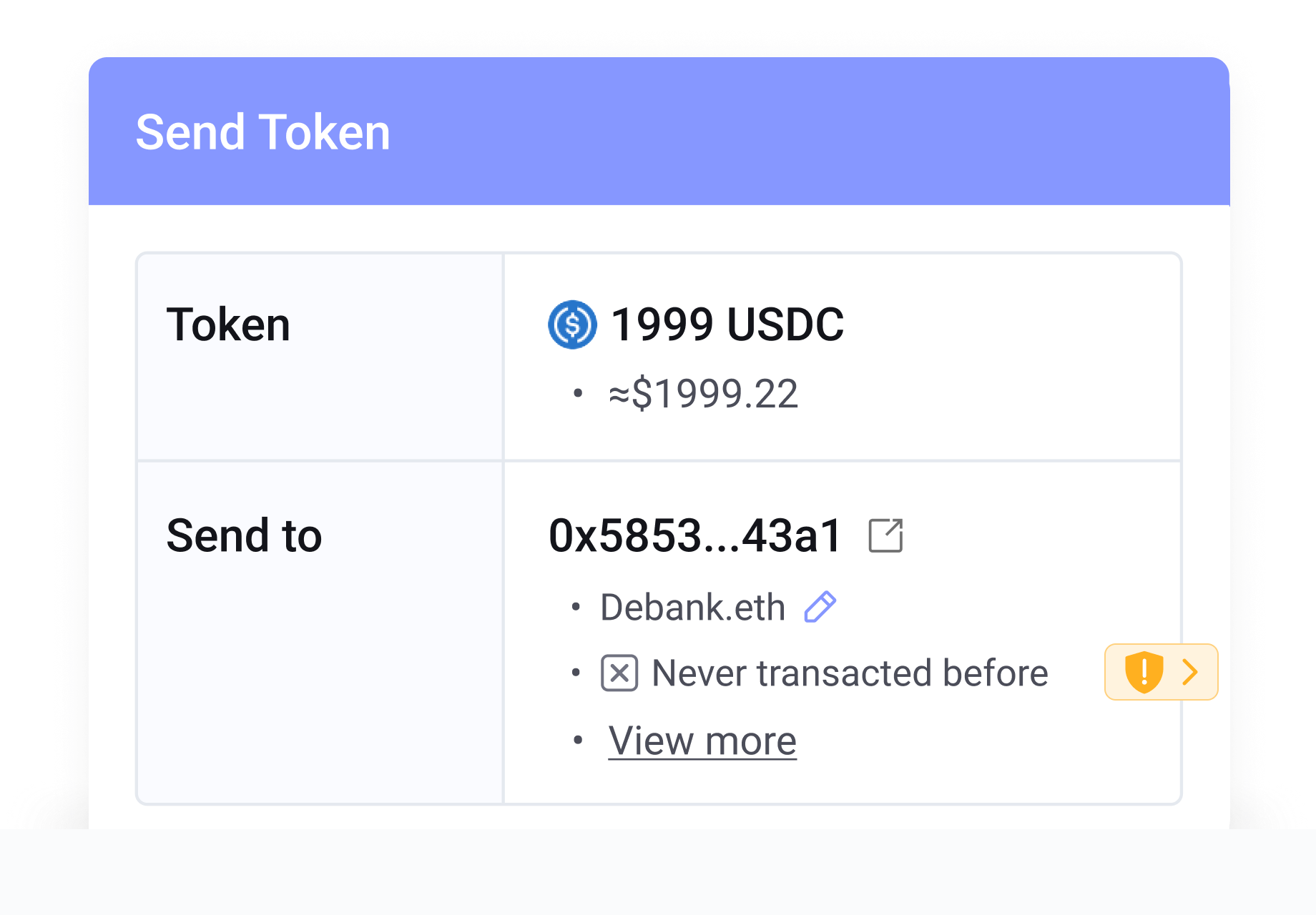
At a mechanism level, transaction simulation executes a dry‑run of the signed transaction on a fork or call trace prior to broadcasting. Instead of simply asking you to approve calldata and an estimated gas fee, Rabby resolves what that calldata will do: which token balances will change, how much will be forwarded to the destination, and whether any approvals or delegate calls are present. It supplements this with a pre‑transaction risk scan that checks the recipient and contract against known exploit signatures, previously reported hacks, and anomalous approval patterns.
The practical result: users see an estimated token balance change and fee cost before signing. That’s not a cosmetic UX detail—it’s a transformation of the decision surface. Rather than trusting the developer UI or raw calldata, you evaluate an outcome: “If I sign this, my wallet will lose X tokens and pay Y in fees.” That is conceptually different from simply seeing “approve 1,000,000 tokenX.”
Why that matters for DeFi power users
DeFi power users operate at the intersection of speed, composability, and risk. The very features that make DeFi productive — token approvals, meta‑transactions, batched contract calls — also create opacity. Simulation restores a measure of outcome transparency without requiring you to decode bytecode or step through solidity instruction traces.
Specific benefits for heavy users include:
– Prevention of blind‑signing attacks: Simulation exposes multi‑call transactions and token flows that could otherwise be hidden behind opaque “execute” buttons in dApps.
– Safer approval management: Seeing a simulated balance change reduces the chance of granting perpetual or oversized allowances by accident; combined with Rabby’s built‑in approval revocation, it forms a sensible two‑step control loop.
– Confidence for cross‑chain operations: Rabby supports gas top‑ups and more than 90 EVM networks; simulation helps confirm that a cross‑chain action will deduct the expected assets and not leave funds stranded due to a missing gas token on a target chain.
Trade‑offs and boundary conditions: what simulation does not solve
Simulation is powerful but not omnipotent. First, it depends on the fidelity of the simulation environment. Simulations that run against a stale node, an inaccurate state snapshot, or a different gas/nonce context can produce results that differ from on‑chain outcomes. In practice Rabby mitigates this with near‑real‑time state queries, but the possibility of divergence is a real boundary condition.
Second, simulation cannot retroactively prevent smart contract logic errors: if a contract’s legitimate path contains a bug, the simulation will show the expected loss but cannot change the underlying contract code. Likewise, certain oracle‑dependent or time‑dependent behaviors may execute differently at real block time than in simulation (for example, a price oracle that updates between simulation and execution).
Third, simulation is only as useful as the user’s willingness to act on the information. Presenting an exact balance delta helps users avoid obvious mistakes, but sophisticated phishing flows can still social‑engineer users into ignoring warnings. Rabby’s pre‑transaction risk scanning helps, but user behavior remains the last line of defense.
How Rabby stacks up against alternatives
MetaMask, Trust Wallet, and Coinbase Wallet are widely used and continuously improving. Rabby differentiates itself through three practical features that matter to active DeFi traders: built‑in transaction simulation, automatic network switching to the dApp’s required chain, and an explicit “Flip” toggle for users who want to switch between Rabby and MetaMask behavior. For institutional users, Rabby’s integrations with multi‑sig and custody providers (Gnosis Safe, Fireblocks, Amber, Cobo) lower friction for operational security.
Open‑source architecture under the MIT license is another point of strength: independent audits and community scrutiny are feasible and encouraged. Yet openness doesn’t eliminate risk — remember the 2022 Rabby Swap exploit and the team’s response. That episode shows both the reality of smart contract ecosystem risk and the importance of active incident response and remediation practices.
Practical heuristics for DeFi power users (decision‑useful takeaways)
Use these heuristics as reusable shortcuts when interacting with dApps:
– Treat simulation as a required step on complex flows: for multi‑call transactions, approvals over a threshold, or bridge operations, pause for the simulated balance deltas. If the delta doesn’t match your intent, abort and inspect the calldata with a block explorer or developer tools.
– Combine simulation with hardware signing: Rabby supports Ledger, Trezor, Keystone and others. Use hardware devices for final signing so that simulation informs the human decision while the key remains offline.
– Revoke large allowances proactively: Rabby’s approval revocation paired with simulation gives you a control loop — grant minimal allowances, confirm them with a simulation, and schedule routine revocation reviews.
– Watch for oracle/time dependencies: If the simulation outcome hinges on a market price or a scheduled update, recognize the temporal risk window between simulation and finalization.
Near‑term implications and signals to monitor
If transaction simulation proves effective at reducing user losses and phishing success, we should expect three measurable changes: more dApps will surface machine‑readable transaction previews to integrate with wallets; hardware wallets and custodians will expose richer pre‑sign hooks; and insurance/product offerings may treat simulated signing as a risk‑mitigating control. Conversely, if on‑chain engineers find ways to make crucial behavior conditional on unverifiable off‑chain inputs, the utility of simulation will be reduced — that’s a signal to watch in protocol design conversations.
For US users specifically, the absence of a fiat on‑ramp in Rabby matters: simulation reduces operational risk but does not solve regulatory or compliance frictions around fiat access. If you need easy fiat flows, you’ll still chain Rabby to external services, which adds integration risk to your stack.
FAQ
Q: Can simulation prevent every scam or hack?
A: No. Simulation makes outcomes transparent before you sign, which blocks many blind‑signing attacks and accidental approvals. But it cannot change malicious contract logic, prevent social‑engineering, or correct inaccuracies if the simulation runs against an outdated state. Use simulation as a strong defensive layer, not an absolute guarantee.
Q: Where do I get the Rabby browser extension and apps?
A: For download, documentation, and platform options (Chrome/Brave/Edge extension, iOS/Android mobile apps, Windows/macOS desktop), see rabby wallet. Always verify the source URL and confirm signatures when possible before installing a wallet extension.
Q: Should institutions rely on Rabby for custody?
A: Rabby integrates with enterprise custody and multi‑sig solutions, which helps operations. But institutions should treat Rabby as part of a layered architecture: combine it with hardware security modules, custody providers like Fireblocks, and internal policy enforcement. Simulation improves human decision‑making but does not replace enterprise governance.
Q: Does Rabby support all EVM chains I might need?
A: Rabby supports over 90 EVM‑compatible chains, including the major networks (Ethereum, BNB Chain, Arbitrum, Optimism, Polygon, Avalanche). For obscure or newly launched chains, verify compatibility and test small transactions first. Automatic network switching reduces friction but does not absolve you from network‑specific risks.
Closing thought: transaction simulation reframes signing from an act of trust in data to an act of consent to an explicit outcome. For DeFi power users — traders, LPs, and institutional operators — that reframing reduces a predictable class of mistakes. But as with any tool, its value depends on integration with hardware signing, approval hygiene, and operational discipline. Where simulation is strongest, it converts uncertainty into an inspectable signal; where it is weakest, it forces you to ask better questions and build stronger controls.